
Law Firms Looking to Deploy Gen AI Can Do Better than Copilot
As lawyers and their clients gain exposure to generative AI through tools like ChatGPT, there is increasing pressure to integrate this technology into legal workflows. Given that law firms and many other enterprises exist in a Microsoft-centric ecosystem, Microsoft's Copilot is sometimes viewed as an easy and comprehensive "solution."
We would argue that, in a legal context, Copilot offers a number of benefits, but, as a product, it is neither comprehensive nor, necessarily, a "solution" at all.
Before one can consider "solutions" it is first necessary to identify the "problem" being solved. Unfortunately, firms often try to jump straight to the search for "solutions" before identify the problems generative AI is capable of addressing in the first place.
By now, most lawyers know that AI tools can help with an array of tasks such as extracting information from documents and generating text in accordance with a set of given instructions. More specifically, generative AI is especially good at extracting information from so-called "unstructured" documents like Word documents and PDF files, as opposed to structured information stored in a database or Excel table. Where information is already catalogued and labeled, traditional search and query methods remain more effective. In respect of generating text, AI models excel at drafting fluid text in almost any style or language, but suffer from a lack of accuracy and verifiability.
Copilot uses a technique known as "retrieval-augmented generation" (or RAG) which provides the ability to search through unstructured documents to extract relevant information and enhance accuracy of generated responses with citation to specific sources. For an explanation of RAG, please see our video: DE-Mystifying AI Series: What is "RAG"?
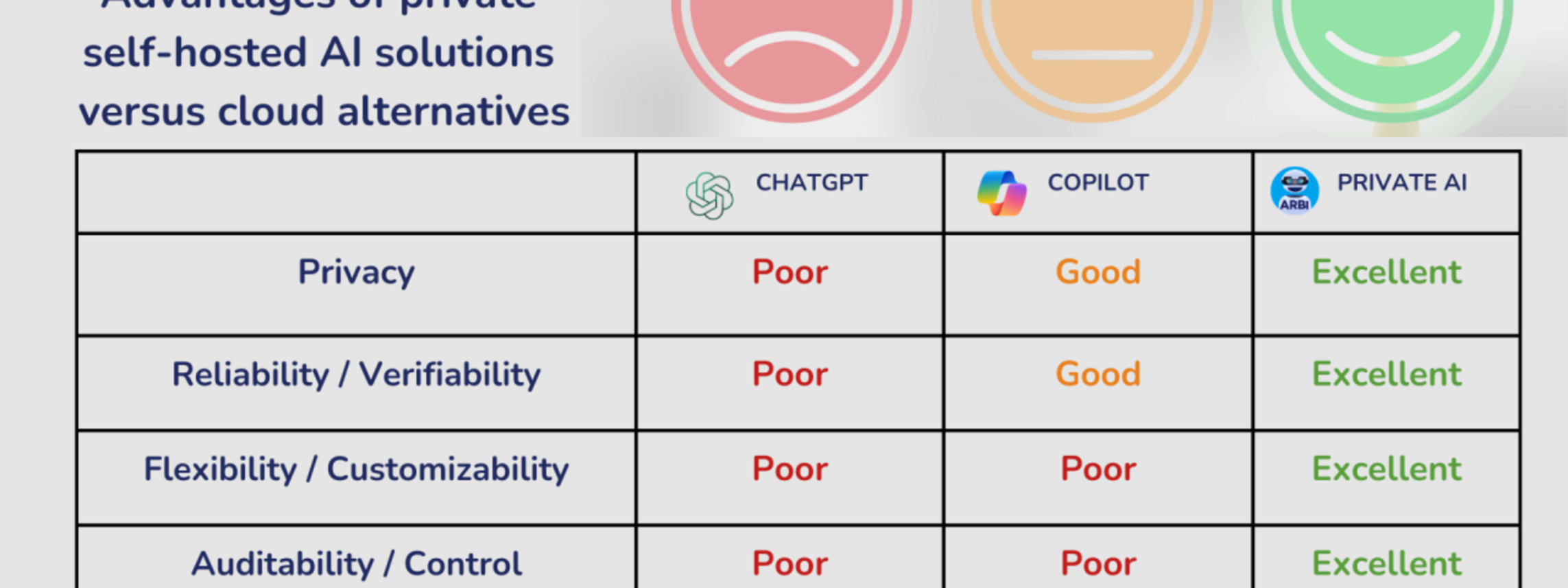
Unfortunately, Copilot offers only a very basic RAG solution, with almost no ability to make customisations to improve performance on specific tasks. Moreover, the system is opaque insofar as it does not reveal the precise instructions and material submitted to the AI model, which directly influences the output produced.
Furthermore, while Copilot comes with much better privacy terms than ChatGPT, it still involves transmitting all data to an AI model located on Microsoft servers, which might raise concerns for certain clients or firms used to keeping all data in-house.
Last but not least, there is the issue of cost. At £300 per user per year, a 1000-person firm can pay in excess of £300,000 per year in costs, irrespective of how much the product is actually used.
Fortunately, it is not especially difficult for firms to deploy their own self-hosted AI solutions that provide better privacy, reliability, customizability, control and long-term value. A number of firms are already beginning to deploy such solutions, whether on their own or with the assistance of custom solution providers.
To learn more about our self-hosting services including ARBI BOX, our custom-built AI device, please visit our AI Solutions Page.